Every researcher, student, writer, and professional faces the same question in 2026: when you need to find reliable information fast, do you open ChatGPT or Perplexity?
Both tools have AI at their core. Both answer questions in natural language. Both have millions of users. But they approach the research problem from fundamentally different angles — and understanding that difference determines whether you get accurate, sourced, current information or a confident-sounding answer that may be months out of date.
The wrong choice wastes time. The right choice changes how you work.
This editorial comparison describes research workflows and questions to check. No controlled research-task experiment supports the article. The scenarios below are suggested evaluations, not measured results or accuracy scores.
Quick Answer
ChatGPT vs Perplexity for research — which is better? Compare the current search tools, cited sources, document handling, analysis workflow, limits, and costs for your task. Both can make errors. A cited answer still needs primary-source review; no overall accuracy, reasoning, or writing-quality winner is established here.
The Fundamental Difference
Before the detailed comparison, one distinction explains almost every difference between these tools:
Perplexity offers search-based answers. Check the selected mode, whether a search was performed, and which sources support the answer. Do not assume every response performs a fresh search or cites every claim.
ChatGPT combines general reasoning with optional web search. Its model knowledge has a cutoff, but Search is available on Free and paid plans and may run automatically when current information would help. Search responses may include citations. For current facts, check whether Search was used and open its sources.
Compare the workflow you actually use: search-grounded answers and responses based only on model knowledge have different verification needs.
See the current feature comparison below. The previous infographic used obsolete paid-only Search and GPT-4o mini labels, so it is no longer shown as a current comparison.
Head-to-Head Comparison — 8 Research Scenarios
Scenario 1: Current Events and Recent Developments
The task: "What are the most significant AI model releases in the past 30 days?"
Suggested evaluation: Check whether a current search was performed, then open the primary announcements and verify dates. No release-list accuracy or response-time result has been measured here.
Scenario 2: Academic Literature and Scientific Research
The task: "What does recent research show about the effectiveness of spaced repetition for long-term memory retention?"
Suggested evaluation: Locate the original papers, check study design, authors, dates, and whether each citation supports the specific conclusion. A search mode or citation list does not guarantee peer review or citation accuracy.
Scenario 3: Complex Multi-Step Analysis
The task: "A startup has $500,000 in funding, 6 months of runway, and 3 employees. Analyze whether they should prioritize hiring a sales person or a second developer, given they have a working product with 50 paying customers but no dedicated sales process."
Suggested evaluation: Treat the startup figures as an illustrative prompt, not a real business case or verified financial result. Compare assumptions, missing information, alternatives, and independently checkable reasoning; no analytical-depth winner has been measured.
Scenario 4: Fact Verification and Accuracy Checking
The task: Verify 10 specific factual claims including company founding dates, current statistics, recent policy changes, and scientific measurements.
Suggested evaluation: Prepare claims with independently established answers, request primary sources, and check each response against those sources. The former nine-versus-seven accuracy results were unsupported and have been withdrawn; no replacement score is asserted.
Scenario 5: Historical Research and Established Knowledge
The task: "Explain the causes of the 2008 financial crisis, the regulatory response, and the long-term structural changes it produced in the banking sector."
Suggested evaluation: Compare source coverage, competing interpretations, dates, and support for causal claims. No historical-research quality or synthesis result is available for this guide.
Scenario 6: Competitive and Market Research
The task: "What are the current pricing plans and key features of the top 5 project management tools?"
Suggested evaluation: Open each vendor’s current pricing page, record billing period and usage conditions, and distinguish a promotion from renewal pricing. No five-tool pricing experiment or accuracy outcome has been performed for this article.
Scenario 7: Writing and Synthesizing Research into Documents
The task: Write a 500-word research summary on the current state of quantum computing for a non-technical business audience.
Suggested evaluation: Compare a draft with the brief and the verified research notes. Check source fidelity, readability, omissions, and revisions; no measured writing-quality advantage is established.
Scenario 8: Follow-Up Questions and Research Depth
The task: Start with a broad question and drill progressively deeper through 5 follow-up questions.
Suggested evaluation: Ask follow-up questions and verify whether earlier constraints, sources, and uncertainties are retained correctly. No session-memory or coherence ranking has been measured here.
Full Feature Comparison
| Feature | ChatGPT | Perplexity |
|---|---|---|
| Real-time web search | Check Search use and current limits | Check selected mode, search use, and current limits |
| Source citations | Search responses may include citations | Yes — numbered, linked citations |
| Free plan quality | Everyday text chat, Search, and separately limited tools | Unlimited standard — capable |
| Knowledge cutoff | Model knowledge has limits; verify dated sources | Search access does not remove model-knowledge limits |
| Writing quality | Assess your brief and revisions | Assess your brief and revisions |
| Reasoning depth | Check assumptions and conclusions | Check assumptions and conclusions |
| Fact verification | Open and verify Search citations | Easy — sources visible |
| Academic mode | No | Yes — searches peer-reviewed literature |
| Current statistics | Verify original source and date | Verify original source and date |
| Context across session | Verify retained constraints | Verify retained constraints |
| Multi-step analysis | Verify each dependent step | Verify each dependent step |
| Image understanding | Yes | Yes |
| File upload | Yes | Yes (paid) |
| Free daily limit | Check account and task limits | Check account and search-mode limits |
| Paid plan | $20/month (Plus) | $20/month (Pro) |
| API access | Yes | Yes |
| Mobile app | Yes | Yes |
Related articles
AI Tools
Perplexity AI Review 2026: The Best Free AI Search Engine?
Explore Perplexity AI for research in 2026: sourced answers, search workflows, plan considerations and limitations compared with other research tools.
AI Tools
25 Best ChatGPT Alternatives in 2026 (Free & Paid)
25 ChatGPT alternatives compared for 2026 — free and paid, ranked by what each is actually best at: coding, research, reasoning, privacy, and more.
When to Consider Perplexity
Current Information Is Required
Any research question where the answer could have changed in the past 6 to 12 months — use Perplexity. Market data, company information, regulatory changes, technology releases, pricing, statistics, recent studies, news events, policy changes — Perplexity's live web access produces reliable current answers where ChatGPT produces potentially outdated ones.
This is not a marginal advantage. For research where currency matters — and in business, science, technology, and current events it almost always does — the difference between a current answer and a 12-month-old answer can make the research useless.
Verification and Source Documentation Are Required
Academic papers, business reports, journalism, and professional research all require sourced, verifiable claims. Perplexity's citation system makes every factual claim in its answer traceable to a specific source. You can check the source, evaluate its credibility, and cite it correctly in your own work.
ChatGPT provides no sources for its factual claims. Even when accurate, the information cannot be verified without independent searching — which defeats the efficiency purpose of using an AI research tool.
Competitive Intelligence and Market Research
Perplexity is the strongest free tool for competitive and market intelligence because it accesses current pricing pages, recent press releases, current product features, and recent industry reports directly. This research category requires current data almost by definition — historical competitive intelligence is not competitive intelligence.
For more on Perplexity's capabilities as a standalone research tool, read the complete Perplexity AI review.
When to Consider ChatGPT
Complex Reasoning and Analysis
When your research question is not "find me the current facts about X" but "help me think through X" — ChatGPT's reasoning depth is the stronger tool. Analyzing a business situation, working through a strategic decision, evaluating competing explanations for a phenomenon, or constructing an argument — these tasks require sustained reasoning, not web search.
The distinction matters. A lot of what people call "research" is actually analysis — taking known information and reasoning about it carefully. ChatGPT is significantly better at this than Perplexity.
Writing Research Output
If the end goal is a written document — a report, an essay, a summary, an analysis — ChatGPT's writing quality is substantially better than Perplexity's. The gap shows up in narrative flow, paragraph construction, the ability to make complex ideas accessible, and the overall quality of prose.
Use Perplexity to gather the facts. Use ChatGPT to write them into something worth reading.
Historical and Established Knowledge
For research into topics where the relevant information is stable and well-established — historical events, scientific principles, foundational concepts in any field, biographical information about historical figures — ChatGPT's training data depth is an advantage. The information has not changed, so the cutoff limitation is irrelevant, and ChatGPT's deeper synthesis of established knowledge often produces more comprehensive answers than Perplexity's web search.
Extended Research Conversations
When your research involves a sustained conversation — building understanding through many exchanges, exploring a topic from multiple angles over an extended session, or working through a complex problem iteratively — ChatGPT maintains conversational context more coherently. The research feels more like working with a knowledgeable collaborator and less like running repeated searches.
For more on using ChatGPT effectively for research and other tasks, read the complete prompt engineering guide.
Free Plan Comparison — What You Get Without Paying
Perplexity Free:
- Unlimited standard searches with live web access
- Citations on every response
- 5 Pro searches per day (more powerful AI model)
- Academic mode for peer-reviewed literature search
- No account required to start
ChatGPT Free:
- Everyday text chats, subject to abuse-prevention safeguards
- Available models depend on current plan and rollout
- Search available on Free, subject to usage limits
- Image upload and analysis available
- Search responses may include citations
Free plan research verdict:
Perplexity offers a search-first research workflow, while ChatGPT Free also supports Search and source citations. Compare the sources returned for your task and the applicable usage limits; free web access is available in both products.
For writing and analysis tasks, ChatGPT's free everyday text chat provides better quality output than Perplexity for tasks where search is not the primary requirement.
Paid Plan Comparison — $20/Month
Perplexity Pro ($20/month):
- Unlimited Pro searches (more powerful AI model)
- File upload for document research
- Multiple AI model options (including GPT-4o and Claude)
- Higher usage limits across all features
ChatGPT Plus ($20/month):
- Expanded messages and uploads
- Search, also available on the Free plan
- ChatGPT Images with expanded access
- Advanced reasoning models, subject to plan and rollout
- Advanced data analysis tools
Related articles
AI Tools
GPT-6 Astra: Release Date, Pricing, Access and Benchmarks
GPT-6 Astra explained: release date, ChatGPT and API pricing, access, benchmarks vs Claude Fable 5.1 and GPT-5.6 Sol, and the AGI claim.
AI Tools
ChatGPT vs Claude vs Gemini: Which AI Wins in 2026?
Compare ChatGPT, Claude, and Gemini by writing, coding, research, document workflows, free-plan limits, and practical selection criteria.
Paid plan research verdict:
ChatGPT Search is available on Free as well as Plus — though Perplexity's citation system and dedicated research interface remain cleaner for pure research workflows. ChatGPT Plus provides better value for users who need both research capability and writing/generation tools in one subscription.
If research is your primary use case — Perplexity Pro at $20/month is the better investment. If you need research plus writing, coding, and image generation — ChatGPT Plus covers more ground at the same price.
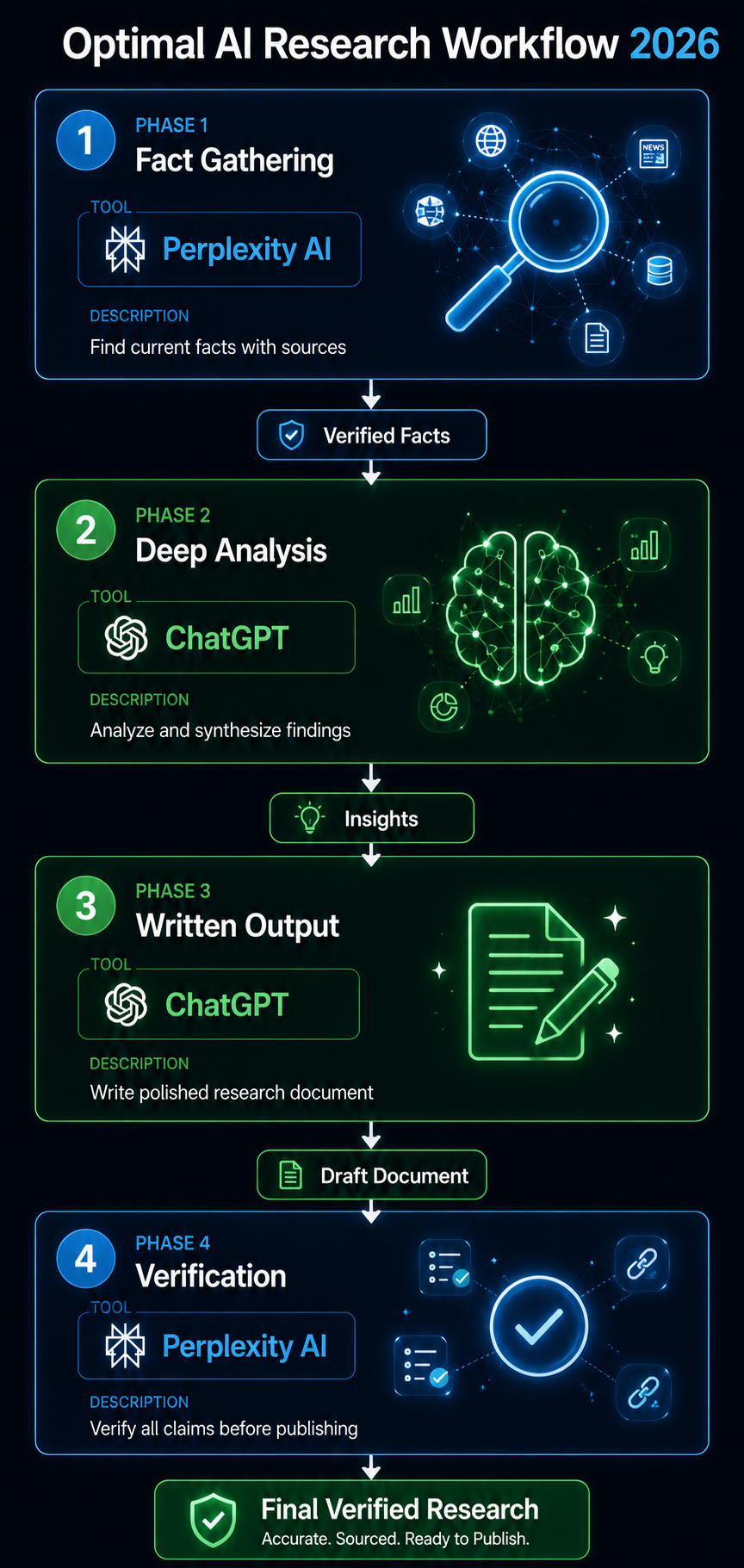
The Optimal Research Workflow — Using Both Tools
The most effective research workflow in 2026 does not choose between ChatGPT and Perplexity. It uses each for what it does best.
Phase 1 — Fact Gathering (Perplexity)
Start every research project in Perplexity. Use it to:
- Identify the current state of your topic
- Find recent statistics and data points with sources
- Discover key players, publications, and perspectives
- Build a sourced foundation of current, verified facts
- Identify academic literature in Academic mode
Perplexity research prompt template: Research [your topic] comprehensively. I need:
Current state — what is happening right now Key statistics and data points with sources The main perspectives or debates in this area Recent significant developments (past 6 months) The most authoritative sources I should read directly
Cite every factual claim with a numbered source.
Phase 2 — Deep Analysis (ChatGPT)
Take the sourced facts from Perplexity into ChatGPT for analysis: I have gathered the following research on [topic]: [paste your Perplexity findings] Now help me:
Identify the most important patterns and insights in this information Analyze the implications for [your specific context] Identify what is missing or what questions remain Evaluate competing perspectives on the key debates Draw conclusions that go beyond what any single source says
Think through this carefully and show your reasoning.
Phase 3 — Written Output (ChatGPT)
Use ChatGPT to produce the final written document: Using the research and analysis we have developed, write a [document type] about [topic]. Audience: [describe your specific audience] Length: [word count or page target] Tone: [formal/conversational/technical] Key arguments to make: [list them] Sources to reference: [list key ones from Perplexity] Write this as a polished, publication-ready document.
Phase 4 — Verification (Perplexity)
Before finalizing, return to Perplexity to verify specific claims: Verify these specific facts for me: [list the key factual claims in your document] For each: confirm accuracy, provide current source, and flag anything that may have changed recently.
This is an illustrative division of work. You may use either or both tools; verify sources and the final document independently. The workflow does not establish a measured quality or efficiency improvement.
Specific Research Use Cases — Which Tool to Use
| Research task | What to verify |
|---|---|
| News and current data | Search use, original announcements, dates |
| Academic literature | Original papers, method, citation support |
| Competitive research | Official current plans, billing and usage |
| Historical research | Primary records and competing interpretations |
| Business analysis | Assumptions, alternatives, evidence |
| Written reports | Brief, source fidelity, readability |
| Fact verification | Independent primary-source confirmation |
| Technical explanations | Official documentation and working examples |
| Bibliographies | Real publications and accurate metadata |
| Follow-up questions | Retained context and source consistency |
Accuracy and Hallucination — The Critical Research Concern
The most serious research limitation of any AI tool is hallucination — generating plausible-sounding but incorrect information with confidence. For research, an undetected hallucination that makes it into a published document, academic paper, or business report is a significant problem.
Perplexity's approach to hallucination: Perplexity's citation system does not eliminate hallucination but it makes hallucinations detectable. Every claim is linked to a source. If the claim does not match the source, or if no credible source supports it, you can identify the error before it propagates. The research discipline of checking sources catches AI errors before they matter.
ChatGPT's hallucination risk: Without Search, ChatGPT can produce confident factual claims without a verifiable source. Search responses may include citations, but those sources can still be incomplete, outdated, or misrepresented. Open the primary source and verify that it supports the specific claim.
The practical implication: For any factual claim used in an important document, open the primary source and check that it supports the exact statement. Review dates, context, and uncertainty regardless of the assistant used; no comparative verification-time gain is established here.
If you're on the other side of this — trying to find out whether your own site gets cited when people ask ChatGPT or Perplexity questions in your niche — that's a related but separate discipline, covered in our best AI search rank tracking tools guide.
Common Research Mistakes with Both Tools
Treating ChatGPT's confident tone as evidence of accuracy. ChatGPT's fluent, confident writing style is not correlated with factual accuracy. It expresses uncertainty and certainty with similar prose quality. Always verify specific factual claims — especially statistics, dates, names, and recent events.
Not using Perplexity's Academic mode for scholarly research. Standard Perplexity searches include all web sources — blogs, news, Wikipedia. Academic mode filters specifically for peer-reviewed literature. For research requiring scholarly sources, Academic mode produces dramatically more appropriate results.
Using ChatGPT for current market or business data. Company valuations, product pricing, market share statistics, regulatory requirements — these change frequently. ChatGPT's training data on these topics is frequently outdated. Use Perplexity for any business data where currency matters.
Not asking follow-up questions. Both tools produce better research when you push deeper. A first response is a starting point. Follow up with "What are the main counterarguments to this?" or "What does the evidence actually show?" or "What is the strongest objection to this conclusion?"
Copying AI research output without reading sources. Perplexity provides sources. Read them — at minimum skim the key ones. The source often contains nuance, context, and qualification that the AI summary simplifies or omits.
Expert Tips for Better AI Research
Tip 1 — Separate source gathering from analysis. You can use one or more assistants, but first verify the source material and then check that the draft accurately represents it. No efficiency advantage is established for a particular tool combination.
Tip 2 — Use Perplexity's follow-up feature aggressively. Perplexity remembers your conversation context. Ask progressively deeper questions rather than starting new searches. "Tell me more about [specific point]" and "What are the limitations of this approach?" drill into the topic without losing the established context.
Tip 3 — Give ChatGPT your Perplexity research as context. Paste your Perplexity findings into ChatGPT before asking for analysis. This grounds ChatGPT's reasoning in current, verified facts rather than potentially outdated training data.
Tip 4 — Use specific prompts, not general questions. "What is machine learning?" produces a textbook answer. "What are the practical limitations of machine learning for small business applications with limited data?" produces specific, useful research output.
Tip 5 — Ask both tools to identify what they do not know. "What aspects of this topic are uncertain or actively debated?" and "What information would change this conclusion?" produce more useful research output than asking only for confident answers.
For more on effective AI prompting for research and other tasks, read the complete prompt engineering guide.
Key Takeaways
-
Compare source support, account limits, and your full review workflow; no measured winner is established.
-
Both Perplexity and ChatGPT Free offer web-search workflows; inspect the cited sources and plan limits
-
ChatGPT's confidence does not indicate accuracy — always verify specific factual claims regardless of how certain it sounds
- For current business data, events, and statistics, use web search and verify primary-source dates in either product
Frequently Asked Questions
Is Perplexity better than ChatGPT for research? There is no measured winner here. Compare current search access, source relevance, citation support, document handling, review workload, and account limits for your research task.
Does ChatGPT have access to current information? Yes. ChatGPT Search is available on Free and paid plans, subject to usage limits. It may search automatically when current information would help, or you can select Search manually. Search responses may include source citations; open those sources to verify important claims.
Is Perplexity AI accurate? Perplexity can return useful sources but can also misrepresent them, miss context, or rely on an outdated page. Check the original sources; search and citations do not establish a comparative accuracy rate.
Can Perplexity replace Google for research? Perplexity replaces much of what people use Google for in a research context — getting a direct answer to a question quickly. It does not replace Google for local search, shopping, navigation, or visual search. For research questions specifically, Perplexity often provides faster and more useful answers than Google by synthesizing multiple sources rather than listing links.
Which is better for academic research — ChatGPT or Perplexity? Perplexity's Academic mode is better for finding and citing academic sources — it searches peer-reviewed literature and returns real paper citations. ChatGPT is better for understanding and synthesizing academic concepts once you have identified the relevant literature. For academic research, use Perplexity to find sources and ChatGPT to help understand and analyze them.
Is Perplexity free? Perplexity offers free access with product- and mode-specific limits. Check current Pro pricing and allowances directly; do not assume unrestricted advanced searches or uploads from an older plan description.
Should I use ChatGPT or Perplexity for a research paper? Use both. Use Perplexity's Academic mode to find peer-reviewed sources and current data with citations. Use ChatGPT to help you understand complex concepts, structure your argument, and write polished sections of the paper. Verify all factual claims through the sources Perplexity provides before including them in your paper.
Conclusion
The ChatGPT vs Perplexity debate has a clear answer for research: they are not competing tools. They are complementary tools that cover different research needs.
Perplexity is a research tool that can write. ChatGPT is a writing and reasoning tool that can research. Understanding that distinction clarifies exactly when to use each one.
For finding current, sourced, verifiable information — Perplexity. For analyzing, reasoning through, and writing about that information — ChatGPT. For most serious research tasks, you need both.
The researchers getting the most out of AI in 2026 are not the ones who picked the best single tool. They are the ones who built a workflow that uses the right tool for each phase of the research process — and that workflow almost always includes both Perplexity and ChatGPT.
For more on AI research and productivity tools, read the complete Perplexity AI review, the ChatGPT vs Claude vs Gemini full comparison, the best AI productivity tools guide, the complete prompt engineering guide, and the what is AI SEO guide for more on getting the best results from AI tools.