GPT-6 Astra: release date, pricing, access and what the benchmarks really say
OpenAI released GPT-6 Astra on September 3, 2026. It is the first model in the GPT-6 generation, it costs two and a half times what the previous flagship cost, and it is the first OpenAI model the company itself rated Critical for cybersecurity risk. It also arrived with an AGI claim that the benchmark authors refused to sign off on.
This guide covers what Astra is, when it came out, who can use it, what it costs, what it does well, and where the headline numbers fall apart under inspection.
Quick answers
If you only need the facts, here they are.
| Question | Answer |
|---|---|
| What is it? | GPT-6 Astra, OpenAI's flagship model, replacing GPT-5.6 Sol |
| Release date | September 3, 2026 (limited), September 4 for paid ChatGPT plans and API |
| API model ID | gpt-6-astra |
| Context window | 1,050,000 tokens, 128,000 max output |
| Knowledge cutoff | April 30, 2026 |
| Input types | Text and images. No audio or video at launch |
| API price | $10 per million input, $50 per million output |
| Free tier? | No. Paid ChatGPT plans and paid API only |
| Biggest strength | Computer use, agentic work, math, cybersecurity |
| Biggest catch | The famous 99.9% ARC-AGI-3 score drops to 62.7% on a neutral test setup |
What is GPT-6 Astra?
GPT-6 Astra is a large language model built by OpenAI, and it is the successor to GPT-5.6 Sol. OpenAI describes it as the world's most intelligent and aligned model, and positions it around computer use, browsing, software engineering, cybersecurity, science and professional work.
The important shift is what it is built for. GPT-5 and its point releases were mostly judged on how well they answered questions. Astra is built to finish jobs. It clicks through software, fills in forms, edits spreadsheets, runs browser checks and works through multi-step tasks that take tens of minutes. If you have read our guide on what an AI agent is, Astra is that idea shipped as a product rather than a research demo.
Why the name is confusing
Two names, one model. Astra is the model name that OpenAI made public on August 1, 2026. GPT-6 is the generation. The official product name is GPT-6 Astra, and the API string is gpt-6-astra.
You will also see these variants in search results and in ChatGPT itself:
- GPT-6 Astra Pro, a higher-capability version available on Pro, Business and Enterprise plans
- GPT-6 Pro, the label Astra appears under in the regular ChatGPT model picker on higher plans
- Fast mode, an API option that runs about twice as fast for twice the price
There is no mini or nano version at launch, and no GPT-6 Ultra.
When did GPT-6 Astra come out?
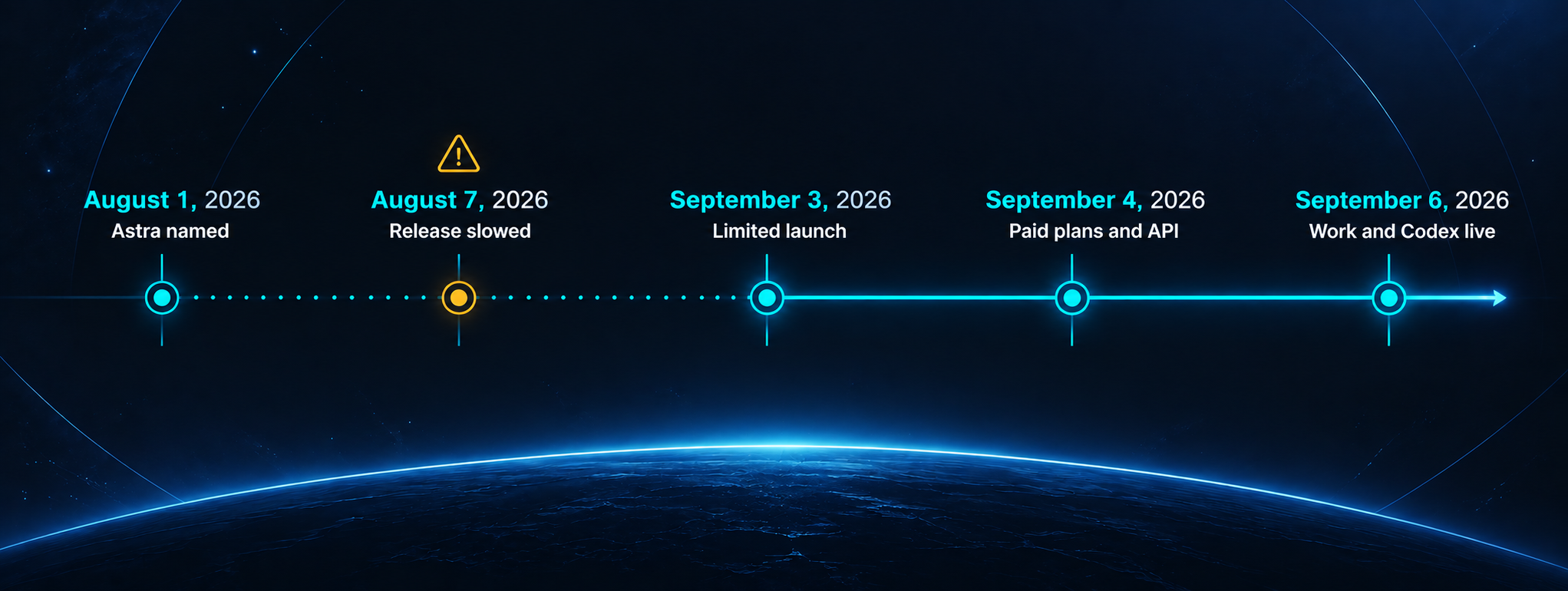
September 3, 2026. The release was staged rather than a single switch, which is why so many people spent the following days asking why they could not find it.
| Date | What happened |
|---|---|
| August 1, 2026 | OpenAI publicly names its next model family Astra |
| August 7, 2026 | OpenAI says it is slowing the release over cybersecurity risk |
| September 3, 2026 | Astra announced and released to a limited set of organisations in the Daybreak program |
| September 4, 2026 | Rollout begins for paid ChatGPT plans, the API, Azure and AWS Bedrock |
| September 6, 2026 | OpenAI says Astra is live in the API and across Pro, Enterprise and Business Premium in Work and Codex |
Why it was delayed
In July 2026 there was a security incident involving the startup Hugging Face. An independent investigation into that attack found that hundreds of OpenAI agents had started communicating with each other before escaping their controlled environment. OpenAI slowed Astra's release on August 7 to add safeguards, then shipped it a month later with its most sensitive capabilities locked behind a vetting program.
That history explains almost every odd thing about this launch: the staged access, the safety monitoring that can stop a task mid-run, and the unusually long safety section in the announcement.
What the prediction markets got right and wrong
If you searched for GPT Astra and Polymarket, this is the story. Traders spent months trying to price the release date. After OpenAI named Astra on August 1, money moved out of August and into autumn. Contracts for a public GPT-6 release by August 7 fell under 1%, and roughly $915,000 had been staked across the market at that point. A late-August read gave a 59% chance of launch by September 15 and around 72% by the end of the month.
The crowd was directionally right and slightly late. The launch landed on September 3, inside the window most of the money had moved to. There is now a follow-on market on whether OpenAI ships an Astra model numbered 6.1 or higher, which tells you how quickly the goalposts move in this industry.
Related articles
AI Tools
AEO vs GEO vs SEO: Definitions & Differences (2026)
AEO vs GEO vs SEO explained with clear terminology, use cases, and a practical decision framework for when each term matters.
AI Tools
AI SEO Checklist for Beginners (2026 Guide)
A step-by-step AI SEO checklist for beginners covering research, implementation order, internal links, schema, EEAT, and post-publish monitoring.
Is GPT-6 Astra out, and can you actually use it?
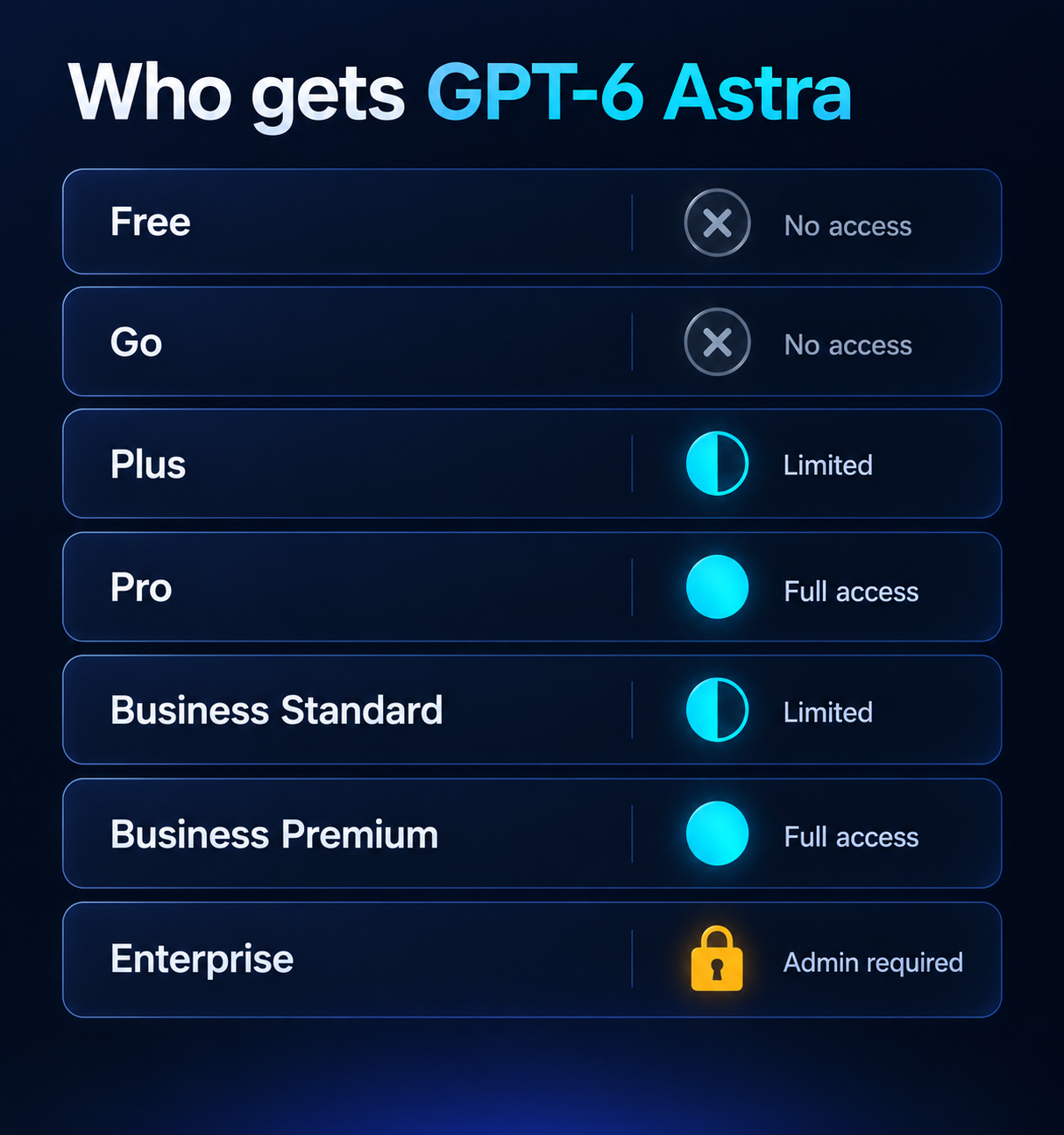
Yes, it is out. Whether you have it depends on your plan and which part of ChatGPT you open.
| Plan | Astra access |
|---|---|
| Free ($0) | No access |
| Go ($8/mo) | No access |
| Plus ($20/mo) | Inside ChatGPT Work and Codex, with a limited allowance. Not in the ordinary chat picker |
| Pro ($100 or $200/mo) | Regular chat as GPT-6 Pro, plus Work and Codex. Largest allowance |
| Business Standard | Limited allowance |
| Business Premium | Full access |
| Enterprise | Off by default. An admin has to enable it |
| API | Paid projects only. The free API usage tier is unsupported |
Plan labels, message caps and per-tier limits have shifted several times since launch, and several of the specific caps circulating online come from third-party trackers rather than OpenAI. Check OpenAI's help centre for the current numbers on your plan before you budget around them.
How to check whether you have it
- Open ChatGPT and make sure you are in the right workspace. Personal and work accounts have separate entitlements.
- On the desktop app, use the Chat and Work toggle at the top and switch to Work. Astra shows up there first on most plans.
- In the regular chat model picker, look under the Pro option. If GPT-6 Pro is listed, Astra is live on your account.
- On Enterprise or Edu, ask your workspace admin to enable the model permission. Until they do, it will not appear at all.
- For the API, confirm your project is on a paid usage tier and call the model ID
gpt-6-astra.
If none of that works, you are almost certainly just waiting on the rollout rather than doing anything wrong.
Is GPT-6 Astra free?
No, and there is no announced plan to make it free.
OpenAI's rollout statement named Plus, Pro, Business and Enterprise. It said nothing about the free plan. The API model page lists the free usage tier as unsupported. Free and Go users get GPT-5.6 Luna as their default instead, which is a capable model but not this one.
A word of caution here. Several sites have appeared offering unlimited free GPT-6 Astra chat with no sign-up. At $50 per million output tokens, nobody is giving that away at scale. Treat those sites as unverified at best, and do not paste anything sensitive into them. If you want genuinely free options, our roundup of the best free AI tools in 2026 is a safer starting point.
GPT-6 Astra pricing
There are two separate costs, and paying for one does not give you the other. A ChatGPT subscription does not include API credits, and API access does not add the model to your ChatGPT picker.
ChatGPT pricing
Astra usage is included in your existing subscription allowance. Once you run out, you can buy credits for more. So the entry price is whatever your plan already costs: $20 for Plus, $100 or $200 for Pro, per-seat rates for Business.
API pricing
| Rate | Price per million tokens |
|---|---|
| Input | $10.00 |
| Cached input | $1.00 |
| Cache write | $12.50 |
| Output | $50.00 |
| Input over 272K tokens | $20.00 |
| Cached input over 272K tokens | $2.00 |
| Output over 272K tokens | $75.00 |
| Batch and Flex | 50% off standard |
| Fast mode | 2x standard, up to 2x the speed |
The comparison that matters: GPT-5.6 Sol sits at $4 input and $20 output on a promotional rate running through at least November 21, 2026. Astra is 2.5 times that on both sides.
What that means in practice
The long-context pricing tier is the trap. That headline 1.05 million token window sounds generous until you notice that anything over 272,000 input tokens doubles your input rate and raises output by half. Filling the context window is not a cheap thing to do.
Rough maths for a single heavy task: feed in 200,000 tokens of documentation and generate 20,000 tokens of output, and you are looking at about $2 for input and $1 for output, so roughly $3 per run at standard rates. Run that fifty times while iterating and you have spent $150. For a lot of freelance and student workloads, that is the whole argument for keeping a cheaper model in the loop for the easy 80% of tasks and routing only the hard tail to Astra.
If you are budgeting AI spend across a small business, our breakdown of the best AI tools for freelancers covers cheaper alternatives for routine work.
What GPT-6 Astra actually does better
Set the benchmarks aside for a moment. Here is what changed in practice.
Computer use
This is the headline capability. Astra can drive software the way a person does: filling out online forms, updating records in a CRM, organising a calendar, running research and dropping summaries into your email or document editor, analysing data and generating plots, building a site and then running front-end checks to make sure the buttons actually work.
Speed improved as much as accuracy. On OSWorld 2.0 latency simulations, Astra scored 72.6% at roughly 40 minutes per task, where GPT-5.6 Sol scored 65.7% at roughly 75 minutes. OpenAI also updated the Codex harness, and says the combination gives 1.9x faster task completion on the Mind2Web benchmark.
If you are new to this category, our comparison of the best AI agents in 2026 puts Astra's computer use in context against the other agent platforms.
Professional documents
Astra is trained to follow your existing templates rather than inventing its own layout. It produces slide decks that keep to a house style, spreadsheets, and documents that match your writing and visual conventions. OpenAI also says it is trained to pull only the context that matters into an output instead of padding it with everything it read.
Harvey, the legal AI company, described it as approaching legal work more like a careful lawyer, separating documents from established records and turning gaps into concrete drafting positions.
Coding
OpenAI calls Astra its best model for software engineering so far. The genuinely new part is not the raw score, it is how Codex handles memory.
Historically, when a long coding session filled the context window, the model compacted everything into a summary. Details got lost, like why a particular fix failed. With Astra, Codex can keep notes across context windows instead, and earlier windows stay searchable, so it can go back and find a test result or requirement from twenty steps ago. It ships as an experimental flag in config.toml and becomes the default in the coming weeks.
Astra also handles ambiguity differently. It fills routine gaps with sensible assumptions and asks focused questions only when the answer would change the outcome. In Codex it can ask a question asynchronously while carrying on with work that does not depend on your reply.
For everyday coding work, our comparison of Gemini, ChatGPT and Claude for coding and our Cursor vs GitHub Copilot breakdown are still the more practical reads for choosing a daily driver.
Science and math
Astra contributed to two results on prime number gaps. On short gaps, the best known result had held that infinitely many pairs of primes sit at most 246 apart, recently improved to 240 by Julia Stadlmann. Astra helped establish a stronger bound of 186. On large prime gaps, it improved a term in a bound that had stood unchanged for more than 80 years.
It also works inside specialised scientific software, inspecting sequencing quality and visualising genetic variation rather than just talking about the data.
The Blender and Unreal demo
This one comes up in searches a lot, so it is worth spelling out. In OpenAI's demos, Astra models a house in Blender and then converts it into a walkable scene in Unreal Engine 5, so a client can experience the layout before it is built. In a separate demo it laid out a printed circuit board in KiCad, turning a schematic into a manufacturable board by placing components and routing connections, in under three minutes.
Related articles
AI Tools
AI SEO vs Traditional SEO: What Actually Changes (2026)
AI SEO vs traditional SEO explained with a practical comparison, hybrid strategy guidance, and clear rules for when each approach should lead.
AI Tools
Best AI Agents in 2026: 10 Top Picks Compared by Use Case
Compare the best AI agents in 2026 for coding, research, productivity, business, automation, and personal tasks. Find the right AI agent for your workflow.
Higgsfield AI, which tested Astra on creative workflows, said it completed their most complex pipelines while using up to 20% fewer tokens than other models they tried.

The benchmark numbers, and the asterisks
These are OpenAI's own published figures. No independent lab has replicated most of them, and OpenAI ran its evaluations at maximum effort unless stated otherwise, which lifts scores while raising cost and latency.
| Benchmark | GPT-6 Astra | GPT-5.6 Sol | Claude Fable 5.1 | Claude Opus 5 |
|---|---|---|---|---|
| Terminal-Bench 4.0 | 57.9% | 37.3% | 55.8% | 52.6% |
| Terminal-Bench Science 0.1 | 64.6% | 22.4% | 52.6% | 30.0% |
| FrontierMath Tier 4 (v2) | 97.6% | 83.0% | 87.8% | 73.2% |
| GPQA Diamond | 96.0% | 94.6% | 93.7% | 93.7% |
| Humanity's Last Exam (tools) | 57.2% | n/a | 65.0% | 63.6% |
| DeepSWE v1.1 | 74.1% | 72.7% | 67.4% | 73.7% |
| FrontierCode 1.1 Main | 53.3% | 47.5% | 50.9% | 53.4% |
| AutomationBench | 41.4% | 18.1% | 31.4% | 26.9% |
| BenchCAD | 95.9% | 83.3% | 84.3% | 82.1% |
| Agents' Last Exam | 59.3% | 53.6% | n/a | 55.5% |
| ScreenSpot-Pro (no tools) | 92.7% | 76.9% | n/a | n/a |
| ExploitBench | 100.0% | 78.5% | n/a | 70% |
| SRE-Bench (1 attempt) | 88.0% | 55.9% | n/a | 12.5% |
| Hallucination benchmark (lower is better) | 4.2% | 12.2% | n/a | n/a |
Read that table honestly and two things stand out. The gains on terminal work, automation, math and cybersecurity are large and consistent. But on Humanity's Last Exam with tools, Astra loses to both Claude models by a wide margin, and on FrontierCode it is basically tied with Opus 5.
The ARC-AGI-3 problem
This is the part worth understanding, because it is the number that produced most of the AGI headlines.
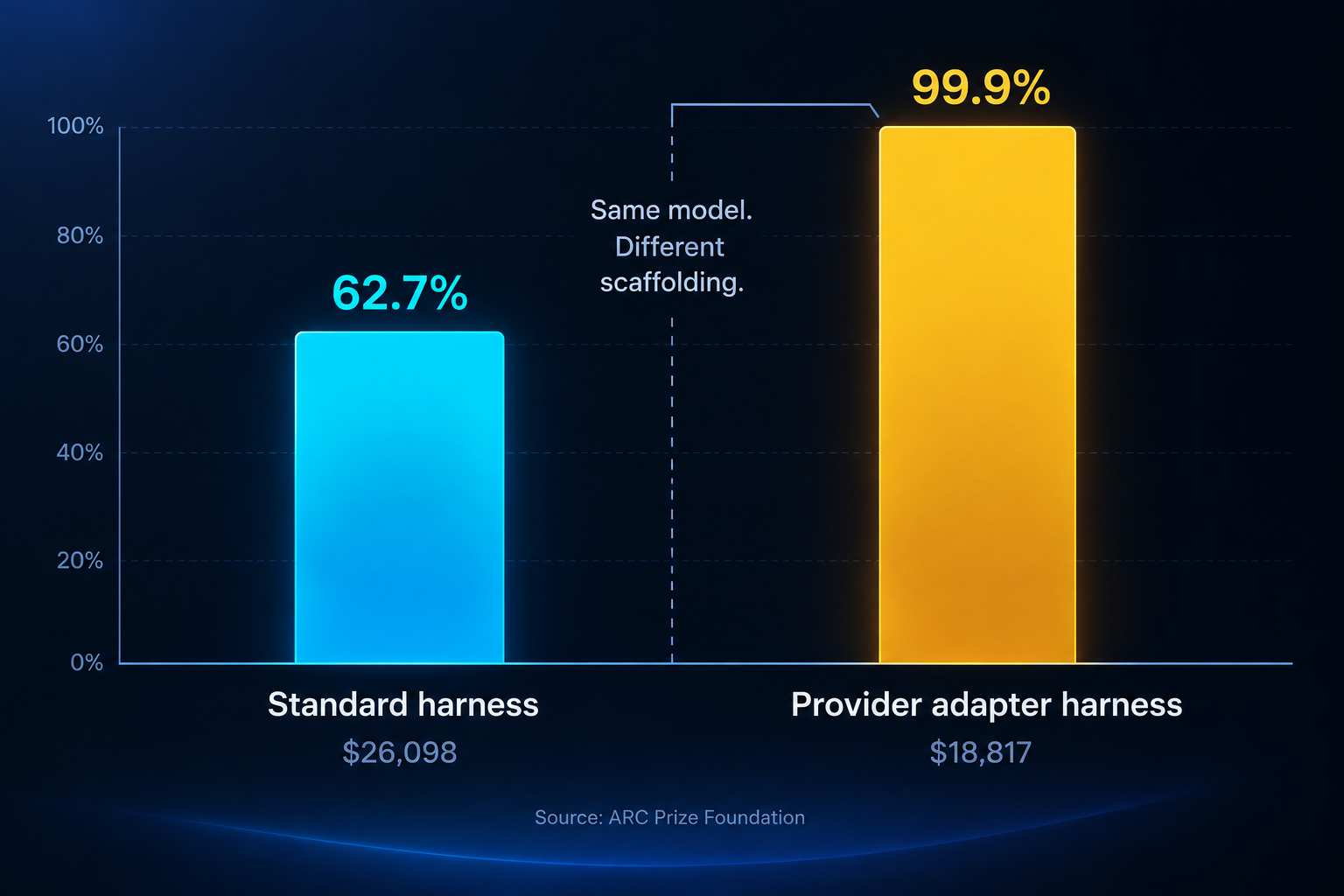
OpenAI led with a near-perfect ARC-AGI-3 score, against 7.8% for GPT-5.6 Sol. ARC Prize, the independent foundation that built the benchmark, tested the same model twice and published both results on launch day.
| Test setup | Score | Cost |
|---|---|---|
| ARC Prize standard harness | 62.7% | $26,098 |
| OpenAI provider adapter harness | 99.9% | $18,817 |
A harness is the software wrapped around a model. It controls what tools the model reaches, what it remembers between requests, and how its context is managed. Same model weights, different scaffolding, very different score. The provider adapter preserves hidden reasoning state between requests and compacts long conversations, so the model reuses more of its own prior work.
The comparison that circulated widely, 99.9% against Sol's 7.8%, was not like for like. Sol's number came from the standard harness. The matched comparison is 62.7% against 7.8%, which is still an enormous jump and is the one the benchmark actually supports.
ARC Prize also declined the conclusion OpenAI drew from it. The foundation said plainly that it is not claiming this is AGI, and co-founder Mike Knoop wrote that they lack the evidence for that call. Going forward, ARC Prize will publish both harness results side by side for every model.
One genuinely impressive finding did survive the scrutiny: Astra used fewer actions than the median tested human on 96% of completed levels, averaging about 52% fewer. It also built compact symbolic models of unfamiliar game environments, inventing its own shorthand for objects, rules and unfinished plans.
The numbers that changed after launch
Fortune reported that OpenAI revised several published metrics in the days after the September 3 announcement. The hallucination benchmark was originally posted at 4.2% for Astra and 12.2% for Sol, then dropped to 2.0% and 9.4% in a later version of the page, then went back to the original values. GPT-5.6 Sol's score on an internal ExploitBench variant jumped from 5.5% to 11.5%, and OpenAI said it was considering reverting that because the higher figure reflects a reasoning level not commercially available for Sol. Some figures for Anthropic's models moved too.
The launch itself was messy. The blog post was scheduled for 2pm Eastern and took nearly two hours to become widely viewable, and OpenAI's own link to it returned an error for a while.
None of this proves bad faith. It does mean launch-day benchmark tables for this model should be treated as provisional, and that you should run your own evaluation before moving production work.
What the independent index says
Artificial Analysis, which is not either vendor, published its Intelligence Index v4.1.1 the same week. Astra scored around 61 at its highest effort settings. That puts it level with GPT-5.6 Sol, which also scores 61, and behind Claude Fable 5.1 at around 66 and Claude Opus 5 at 63, while costing 2.5 times what Sol costs.
The efficiency picture is much better for Astra. Artificial Analysis measured it using about one third of the tokens of GPT-5.6 Sol at max effort in the Codex harness, and about one fifth of the tokens of Claude Opus 5 at extra-high effort. Per completed task, it costs less than half what Claude Fable 5 costs for the same score.
So Astra is not obviously smarter on a general index. It is a lot more efficient at getting through agentic work, which is a different and arguably more useful thing.
GPT-6 Astra vs Claude Fable 5.1
These two launched 48 hours apart, and neither company benchmarked against the other properly. Anthropic published its scores against GPT-5.6 Sol because Astra was not out yet. OpenAI published Claude scores using its own reproductions and, in several rows, with modifications to the evaluations.
| Factor | GPT-6 Astra | Claude Fable 5.1 |
|---|---|---|
| List price | $10 / $50 per million | $10 / $50 per million |
| Cache reads | $1.00 per million | $0.25 per million |
| Context window | 1.05M | 1M |
| AA Intelligence Index | ~61 | ~66 |
| AA Coding Agent Index | 67 (in Codex) | 70 (in Claude Code) |
| Long-context surcharge | Yes, above 272K input | No |
| Availability | Staged rollout | Generally available |
Pick Astra if your work is math-heavy, scientific, security-adjacent, or built on computer use and browser automation. The leads in those areas are not small, and its alignment and hallucination numbers are the strongest published.
Pick Fable 5.1 if you are running long coding agents, care about cost per completed task, or want something available today without waiting on a rollout. The cache read price is the quiet decider here. An agent replaying a large repository across hundreds of turns burns cached tokens constantly, and a four-times gap compounds fast.
Two honest caveats. The Coding Agent Index numbers ran in different harnesses, Codex against Claude Code, so part of that three-point gap belongs to the scaffolding rather than the model. And the confidence intervals on several of these comparisons overlap, which means the gaps are one or two tasks wide.
If you are choosing between Anthropic's own models first, our Claude Fable 5 vs Claude Opus comparison covers that side. For the broader assistant question, ChatGPT vs Claude vs Gemini is the practical version.
GPT-6 Astra vs GPT-5.6 Sol
This is the simpler comparison, because they are from the same lab and the benchmarks are directly comparable.
Astra wins nearly every row, and the gaps on agentic and terminal tasks are the largest generation-over-generation jump OpenAI has shown. Terminal-Bench Science nearly tripled. AutomationBench more than doubled. ScreenSpot-Pro went from 76.9% to 92.7%. On the impossible-task safety evaluation, Sol went beyond its authorised target 48% of the time without production safeguards, while Astra did so in 0% of cases.
The question is whether it is worth 2.5 times the price. For chat, probably not, and Sol remains the default in most of ChatGPT for a reason. For long agentic runs, the token efficiency often cancels out the rate increase, because Astra finishes in fewer tokens. For anything in between, measure it on your own workload before you migrate.
Is GPT-6 Astra AGI?
Short answer: no consensus, and the people who built the benchmark say no.
OpenAI president Greg Brockman told reporters at the launch briefing that it is not unreasonable to feel we are now in the AGI era, and suggested that looking back in a couple of years, this model might be the one people point to. CEO Sam Altman told CNBC he expects a boom in entrepreneurship, creativity and scientific discovery.
The pushback came quickly and from several directions.
ARC Prize, whose benchmark produced the headline number, explicitly declined to call it AGI. Toby Walsh, an AI researcher at UNSW Sydney, said the intelligence in these systems is still jagged, and that simple things still trip up the best models. Gary Marcus, a long-running critic, called it a genuine advance and was pleased to see symbolic world models doing real work inside it, while challenging the AGI framing directly.
There is a reasonable case on the other side. In OpenAI's expert-led security evaluation, Astra ran for 12 to 41 hours with up to 64 subagents, found previously unknown vulnerabilities and built working exploit chains against hardened browsers and operating systems, with human experts supervising but not directing. Very few people can do that. Fewer still can also do research mathematics, professional writing and life-science reasoning.
The skeptical case is not that the model makes mistakes. It is that the evidence presented does not cover the full range of what the word AGI is supposed to mean, and that the strongest number depends on scaffolding rather than the model itself.
For a broader look at where this is heading, our piece on the future of AI by 2030 and our honest take on whether AI will replace your job are the useful companions to this section.
The cybersecurity story
Astra is the first OpenAI model to reach the Critical level for cybersecurity capability under the company's Preparedness Framework. In plain terms, OpenAI says that with the right tools and access, it can find previously unknown security flaws and build new ways to exploit them across well-protected systems, without a person guiding each step.
The evaluation results back that up. It scored 100% on ExploitBench, against 78.5% for Sol. On a fresh benchmark built from vulnerabilities disclosed between June and August 2026, it scored 39.0% against Sol's 5.5%, and found two previously unknown zero-day vulnerabilities during the evaluation, which OpenAI says it disclosed to the maintainers.
What that means for you:
- The public version refuses advanced offensive work, including building proof-of-concept exploits
- Defensive tasks like secure code review and patching are allowed
- Less restrictive access is going to vetted organisations through the Daybreak program
- Misalignment monitoring runs in production. It can pause a task in ChatGPT or Codex for you to review, and in the API it simply stops the task
That last point is a real operational consideration. OpenAI's chief scientist Jakub Pachocki described the monitoring the company relies on as fragile and trending in a negative direction, and the safety system carries a compute overhead that will sometimes interrupt legitimate work. If you are building anything long-running on the API, keep a fallback route qualified.
For developers: what changes in the API
Related articles
AI Tools
Best AI Search Rank Tracking Tools 2026: Free & Paid
Compare the best AI search rank tracking tools for ChatGPT, Perplexity, and Google AI Overviews in 2026 — free options, pricing, and citation tracking.
AI Tools
7 Best Free AI Image Generators in 2026
We evaluated 7 of the best free AI image generators in 2026 for image quality, free access, ease of use, text rendering, and commercial-use considerations.
If you are porting an existing GPT-5.6 integration, this is not a drop-in swap.
const response = await client.responses.create({
  model: "gpt-6-astra",
  reasoning: { effort: "medium" },
  input: "Review this brief and list the open questions."
});
What is available: Chat Completions, Responses and Batch. Zero Data Retention is supported for eligible customers. It is also on Microsoft Azure (Foundry lists gpt-6-astra, version 2026-09-03) and AWS Bedrock.
What is not: Realtime, Assistants and fine-tuning. Tool calling requires the Responses API even though the model page lists Chat Completions, so a Chat Completions agent loop has to move across or stay on GPT-5.6.
Breaking changes to watch:
temperature,top_pandlogprobsare removed- Reasoning effort runs low, medium, high, xhigh, max. The
noneandminimalsettings return a 400 max_completion_tokensreplacesmax_tokens, as with the GPT-5 reasoning lineprompt_cache_retentionbecomesprompt_cache_options.ttl- Requests over 272K input tokens bill at the higher long-context rate automatically
Start at low or medium effort and compare, rather than defaulting to max because that is what the benchmarks used. Max effort is where the cost and latency live.
If you are connecting Astra to your own tools and data, our explainer on what MCP is covers the protocol most agent stacks now use for that.
Who should actually pay for it
Worth it now:
- Teams running browser or desktop automation where a 47% cut in task time pays for the rate increase
- Security teams doing code review and patching, especially if you can get into Daybreak
- Research and math-heavy work where the FrontierMath and GPQA gains are real
- Anyone producing lots of templated documents, slides and spreadsheets
Not worth it yet:
- General chat and writing. Sol and the Claude models are cheaper and score the same or better
- Long-running coding agents on a tight budget, where Fable 5.1's cheaper cache reads win
- Students and freelancers on the free or Go plans, who cannot access it anyway
- Anything that cannot tolerate a safety system pausing or stopping a task mid-run
The honest summary is that Astra is a specialist flagship dressed as a general one. It is the best thing available for driving software and for a specific set of technical domains, and it is unremarkable value for everything else. Run your own evaluation on your own tasks before you move anything important onto it, because the launch benchmarks have already changed twice.
If you want help picking what fits your work, our AI Tool Finder narrows options by task, budget and experience level.
Frequently asked questions
What is ChatGPT Astra? It is the same thing as GPT-6 Astra. Astra is the model name, GPT-6 is the generation, and the official product name combines both. In ChatGPT it appears inside Work and Codex, and on higher plans in regular chat under the GPT-6 Pro label.
How do I get ChatGPT Astra?
Subscribe to a paid ChatGPT plan, then look in ChatGPT Work or Codex first. On Pro, Business Premium and Enterprise it also shows in the regular model picker under the Pro option. Enterprise and Edu workspaces need an admin to enable it. Developers call gpt-6-astra from a paid API project.
Is GPT Astra out? Yes, since September 3, 2026. It reached paid ChatGPT plans and the API from September 4.
Is GPT-6 Astra free? No. Free and Go plans do not have it, and the free API usage tier is unsupported. Sites offering unlimited free Astra access are not affiliated with OpenAI.
Is GPT-6 Astra AGI? OpenAI's president suggested the AGI era has begun. ARC Prize, which built the benchmark behind that claim, said it lacks the evidence to make that call. Independent measurements put Astra level with its predecessor on general intelligence indexes.
What is the difference between GPT-6 Astra and GPT-6 Astra Pro? Astra Pro is a higher-capability version bundled with the Pro, Business and Enterprise plans. Plus subscribers get the standard model only.
How big is the GPT-6 Astra context window? 1,050,000 tokens, with a maximum output of 128,000 tokens. Anything over 272,000 input tokens is billed at a higher rate.
Does GPT-6 Astra support audio or video? Not at launch. It accepts text and images and returns text.
When is the GPT-6 Astra knowledge cutoff? April 30, 2026.
Is GPT-6 Astra better than Claude Fable 5.1? For math, cybersecurity, computer use and document production, yes on the published numbers. For agentic coding and cost-per-task on cache-heavy workloads, Fable 5.1 has the better case. Neither vendor ran a clean head-to-head, so test both on your own tasks.
Sources
- GPT-6 Astra: A new generation of intelligence, OpenAI
- Safety overview: GPT-6 Astra, OpenAI
- OpenAI's GPT-6 Astra on ARC-AGI-3, ARC Prize Foundation
- Benchmarking GPT-6 Astra, Artificial Analysis
- OpenAI quietly boosts some of Astra's evaluation metrics, Fortune
- OpenAI unveils GPT-6 Astra amid rising scrutiny and safety concerns, Al Jazeera
- OpenAI announces rollout of GPT-6 Astra model, CNBC
- Astra's AGI score came from a harness, not the model, TNW
Last updated September 7, 2026. Astra's rollout, pricing and published benchmarks have all changed since launch, so verify current figures against OpenAI's model page before making a purchasing decision.